Going below the surface
Today I started prototyping Rittenhouse in brass.
This was less about the full design and more about the surface itself: how far I can push the fiber laser in LightBurn to create texture, depth, and visible relief without cutting too aggressively into the dial blank.
That turns out to be a narrow lane.
I spent most of the session trying different combinations of speed, power, frequency, interval, pass count, and fill strategy, looking for a texture that would still be visible after paint but not so deep that it weakens the dial or punches through the brass entirely. The goal is not engraving for engraving’s sake. It is to create a surface that can hold light — something subtle enough to belong on a watch dial, but present enough to survive finishing.
I burned a lot of brass today.
Some tests were clearly too hot. Some were too faint. Some looked promising on screen and immediately failed in metal. That is the useful part of this process: every bad dial is a data point.
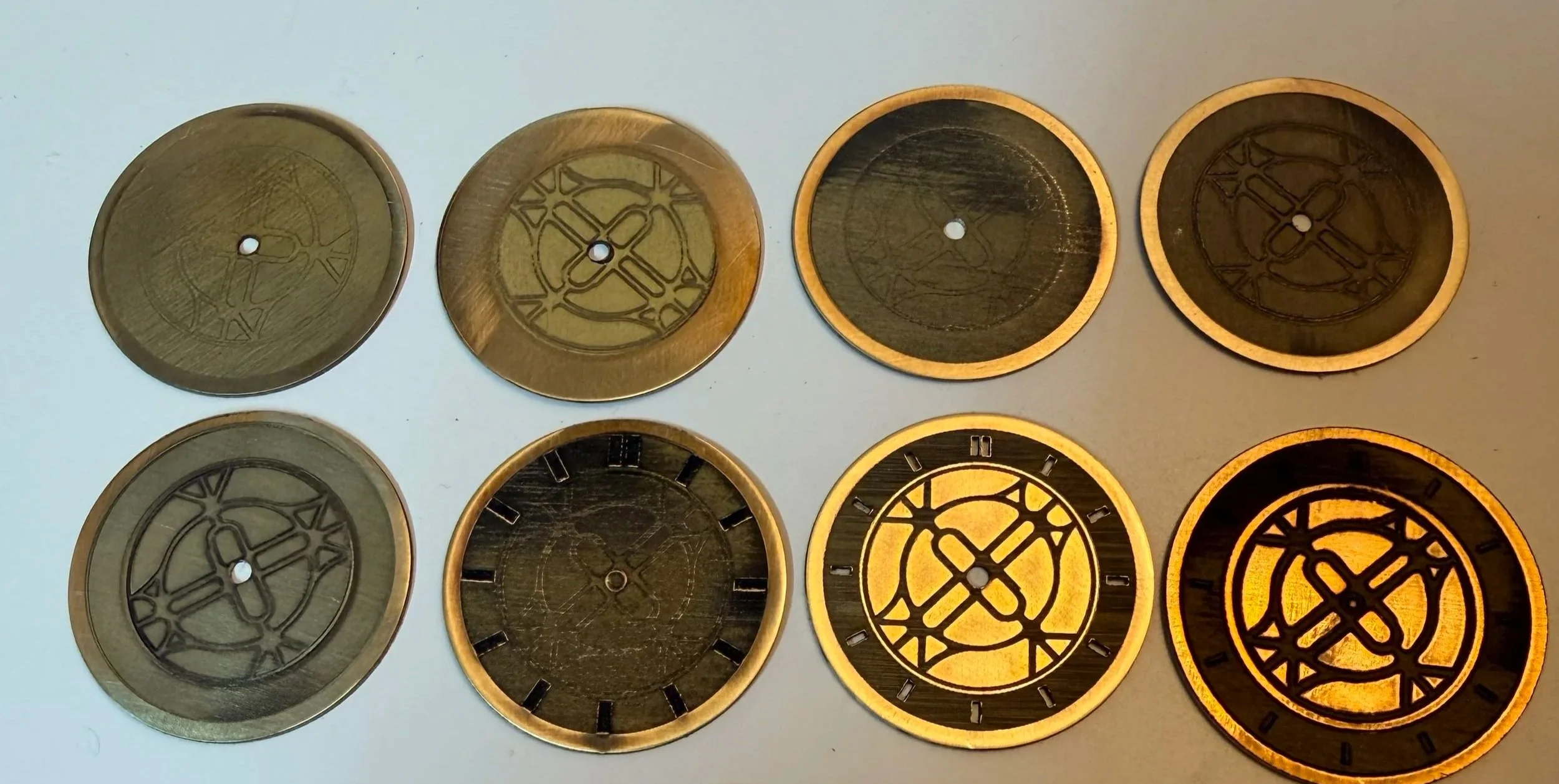
Various attempts and a few design tweaks along the way
By the last prototype, though, I started to see something close to what I had been hoping for. The texture had enough relief to read physically, but it still felt controlled. In case you are wondering, this is both a substrate for paint and a cliché template in one. From a production plan standpoint, I will ultimately plan to laser etch the minute tract and wordmark into a cliché and laser engrave the rest into brass before sanding, degreasing, airbrushing a primer, base color and ultimately pad printing the graphics.
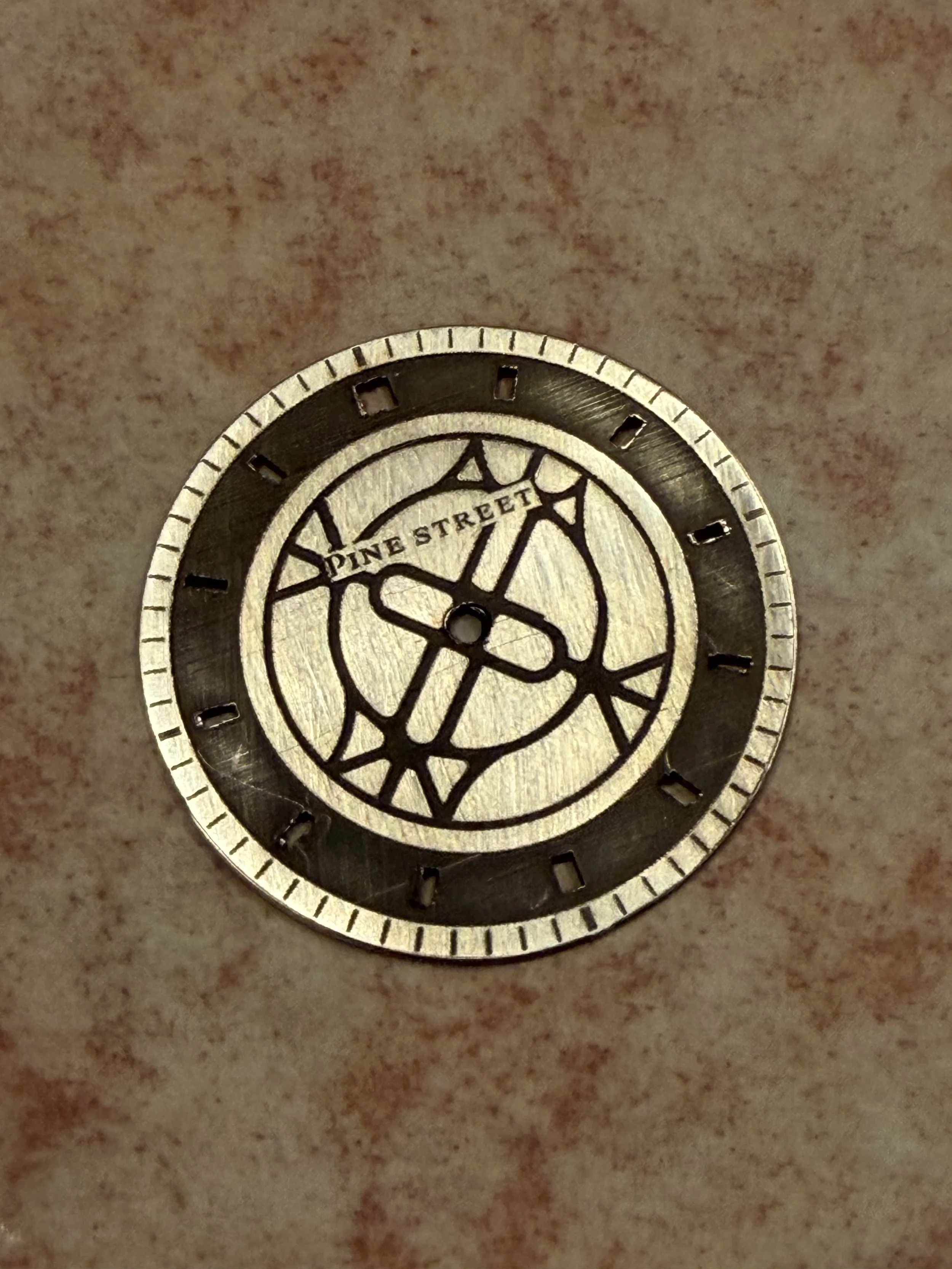
Final prototype of the day
…and its just starting to approach what I see in my head.
The holes in the dark ring are some provisional places for solder for applied indices. That step down the road is already intimidating.
A lot of scorched metal for one small step forward.
I’ll take it.